From Busy to Productive: Measuring What Matters in Your Business
“Without measurement, it’s hard to know whether all the motion happening in your business is actually creating momentum.”
— Krista Beavers
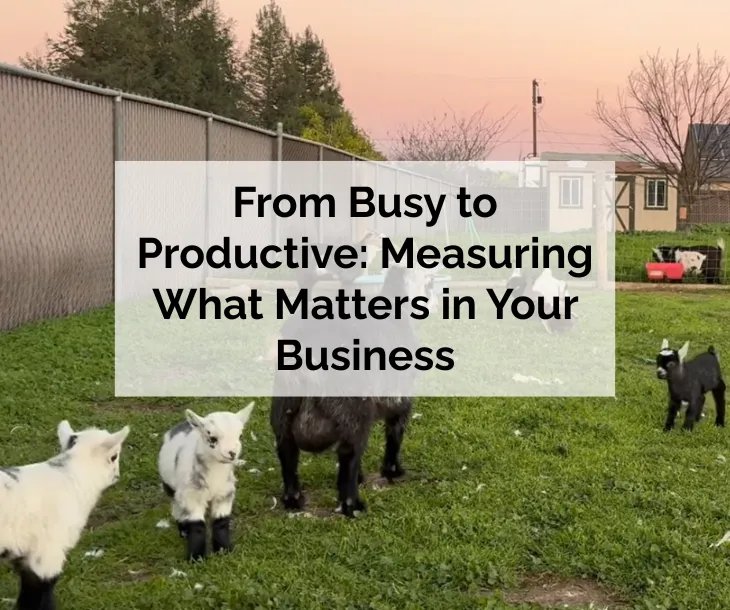
There’s something joyful about watching my pygmy goats at play.
If you’ve ever stood near their enclosure in early spring (or watched my videos of them), you know exactly what I mean. They bounce. They leap. They sprint from one corner to the other with enthusiasm that’s hard not to smile at.
There’s energy everywhere.
But there’s no clear destination.
They aren’t trying to reach a specific point. They aren’t executing a strategy. It’s pure motion — delightful, energetic motion — but motion without direction.
Businesses can look a little like my goats in March.
By now, the year is fully underway and there’s activity everywhere. Meetings are happening. Projects are moving forward. Teams are busy. Invoices are going out.
The energy is there. The effort is there.
But without measurement, it’s hard to know whether all the motion happening in your business is actually creating momentum.
The important question isn’t “Are we moving?” It’s “Are we moving in the right direction?”
Momentum feels good. Measurement makes it productive.
The Hidden Cost of Being Busy
Most organizations don’t struggle with effort. They struggle with focus.
When leaders describe their teams as “busy,” it often means:
Calendars are full.
Email threads are long.
Projects are active.
Revenue may even be increasing.
But busyness and productivity are not the same thing.
Without clear measurement, activity can drift. Revenue may grow while margins quietly shrink. Expenses may creep up unnoticed. Teams may be overloaded without clear alignment to strategic priorities.
Just like the goats — full of energy, but not headed anywhere specific.
The cost of unmeasured activity isn’t just inefficiency. It’s missed opportunity. When leaders don’t define what success looks like — and track it consistently — momentum becomes reactive rather than intentional.
Measurement brings direction to motion.
Tracking What Actually Matters
One of the most common leadership mistakes isn’t failing to track metrics — it’s tracking too many.
Not every number deserves equal attention. So strong leadership requires clarity around which indicators truly support your goals.
A helpful way to think about this is through the lens of leading and lagging indicators. Both are important, but in different ways.
Lagging indicators tell you what already happened. For example:
Revenue
Net income
Quarterly profit
Year-end performance
These are important — but they’re historical.
Leading indicators give you earlier insight. For example:
Project margin trends
Utilization rates
Sales pipeline activity
Client retention quality
Cash flow timing patterns
Lagging indicators confirm results. Leading indicators allow you to adjust before problems grow.
If you only look at revenue, you may miss margin compression. If you only review quarterly profit, you may overlook cost patterns forming mid-quarter.
Tracking what matters means identifying three to five core metrics that align directly with your strategic goals. For example:
If growth is the goal, track revenue quality and margin trends.
If stability is the priority, monitor cash flow consistency and expense ratios.
If scalability is the focus, measure operational efficiency and capacity indicators.
Simplicity creates clarity. And clarity creates confident leadership.
Turning Data Into Confident Decisions
Many businesses collect data. Fewer translate it into meaningful insight.
Dashboards alone don’t create clarity. They provide information — but leadership requires interpretation.
When reviewing your key metrics, ask:
What changed?
Why did it change?
Is this seasonal, structural, or situational?
Does this require action now — or monitoring?
These questions turn numbers into narrative.
For example, if margins dip, is it due to one large project, rising vendor costs, or pricing pressure across multiple clients? If receivables stretch longer than usual, is it a temporary delay — or a shift in payment behavior?
Without interpretation, numbers can create anxiety. With context, they create direction.
This is where financial leadership becomes invaluable. It’s not just about accurate reporting — it’s about connecting trends to operational realities. It’s about helping leadership teams move from “What is happening?” to “What should we do next?”
Confident decisions come from informed understanding, not guesswork.
Course Correcting Early
Spring is early enough in the year to adjust course.
If you wait until Q3 or Q4 to address emerging trends, the correction often becomes more disruptive and more expensive. Small shifts are easier to manage when they’re caught early.
Consider examples like:
Margin compression beginning to show across multiple service lines.
Rising supply or labor costs not yet reflected in pricing.
Slow-paying clients gradually impacting cash flow.
Hiring plans outpacing revenue stability.
Left unmeasured, these issues compound quietly.
Measured consistently, they become manageable adjustments.
My goats eventually settle into patterns within their enclosure. They find their feeding spots. They pause. They recalibrate.
Businesses need that same pause and recalibration. They need intentional review points that ensure motion stays aligned with direction.
Because quarterly KPI reviews aren’t just administrative exercises. They’re leadership checkpoints.
Quarterly KPI reviews aren’t just administrative exercises. They’re leadership checkpoints.
And momentum isn’t about constant acceleration. It’s about steady, informed progress.
KPIs That Support Sustainable Growth
It can be easy to forget — or unintentionally overlook — that not all growth is healthy.
Revenue can increase while profitability declines. Activity can expand while capacity strains. New opportunities can arrive before systems are ready to support them.
Sustainable growth requires KPIs that reflect quality, not just quantity.
Healthy metrics often include:
Profit margin consistency
Cash flow predictability
Client retention quality
Revenue diversification
Operational capacity indicators
Tracking only top-line growth is like watching goats run faster without checking whether they’re heading toward a fence.
True momentum means movement that supports long-term stability.
When you measure strategically, you protect growth from becoming fragile.
From Simple Motion to Sustained Momentum
There’s nothing wrong with energy. In fact, energy is a sign of life in a business.
The key is pairing that energy with direction and measurement.
Measurement turns motion into momentum. Here’s how:
Measurement clarifies priorities.
Priorities focus effort.
Focused effort creates sustainable momentum.
Without measurement, leadership decisions become reactive. With it, they become intentional.
And intentional leadership builds confidence across teams, clients, and stakeholders.
A Simple Leadership Checkpoint for March
As we move further into the year, this is a good time to pause and ask:
Are we measuring what truly drives our strategy?
Are we reviewing leading indicators — or only lagging ones?
Are we busy, or are we productive?
Do we feel confident in the story our numbers are telling?
Just as watching the goats reminds me that motion alone doesn’t equal progress, reviewing KPIs reminds business leaders that activity alone doesn’t equal growth.
Measurement brings purpose to movement.
And purpose creates progress.
Moving Forward With Clarity
March is a natural turning point.
It’s early enough to adjust. Established enough to see trends. And timely enough to protect the momentum you’ve worked to build.
If you’d like support identifying meaningful KPIs, interpreting financial trends, or building a reporting cadence that supports confident decision-making, Guardian Accounting is here to help.
Because financial clarity doesn’t just tell you where you’ve been — it helps ensure you’re headed where you want to go.
To Do this Month:
Identify three to five KPIs that align directly with your strategic goals.
Schedule a dedicated KPI review meeting with your leadership team.
Evaluate whether your current reporting supports confident, timely decisions.
Looking to move from busy to productive this year?
Book a meeting with Krista Beavers to strengthen your financial clarity and protect your momentum.
FAQs
What KPIs should business owners track?
Business owners should focus on a small set of key performance indicators aligned with their goals, such as profit margin, cash flow, client retention, revenue growth, and operational efficiency.
What’s the difference between leading and lagging indicators?
Lagging indicators measure past results (like revenue or profit), while leading indicators provide early signals of future performance, such as pipeline activity or margin trends.
How often should businesses review KPIs?
Most organizations benefit from reviewing KPIs monthly and holding deeper strategic reviews quarterly to identify trends and adjust decisions early.
